Mechanical Engineering
Mechanical Engineering Tutoring
Who this is for
Undergraduate mechanical, civil, aerospace and general engineering students in the core sequence — the courses that quietly decide whether people stay in the major.
This is the field in which I hold my graduate degree.
Advanced Engineering — $90/hr online, $120/hr in person. Full pricing →
What usually goes wrong
- The jump from physics to engineering: the same laws, far less hand-holding, and a free-body diagram that is now the entire problem rather than a preliminary sketch.
- Sign conventions and coordinate choices that are "obvious" to the professor and arbitrary to everyone else.
- Problems with more unknowns than equations, where the missing equation is a physical constraint nobody wrote down.
- Courses that move fast enough that one missed week compounds for the rest of the semester.
Core mechanical engineering tutoring
Statics
Equilibrium, trusses, frames and machines, distributed loads, friction, centroids and moments of inertia — the course the whole sequence is built on.
Dynamics
Kinematics of particles and rigid bodies, Newton's second law, work–energy methods, impulse and momentum, and rotation about a fixed axis. Statics with everything moving: the same diagrams, now with acceleration in them.
Thermodynamics
The first and second laws, properties and state, control-volume analysis, cycles, and entropy. The difficulty here is rarely the algebra — it is choosing the system boundary and then being disciplined about what crosses it.
Fluid Mechanics
Fluid statics, continuity, Bernoulli, momentum analysis, viscous flow, and pipe systems and losses. Bernoulli in particular is a formula students can apply long before they can say where it is allowed to apply.
Additional engineering coursework
Depending on the course and your goals, I may also be able to help with topics such as Machine Design, Mechanical Vibrations, and System Dynamics.
Ask before booking and I will tell you honestly whether your specific course is one I can support well.
How I teach engineering
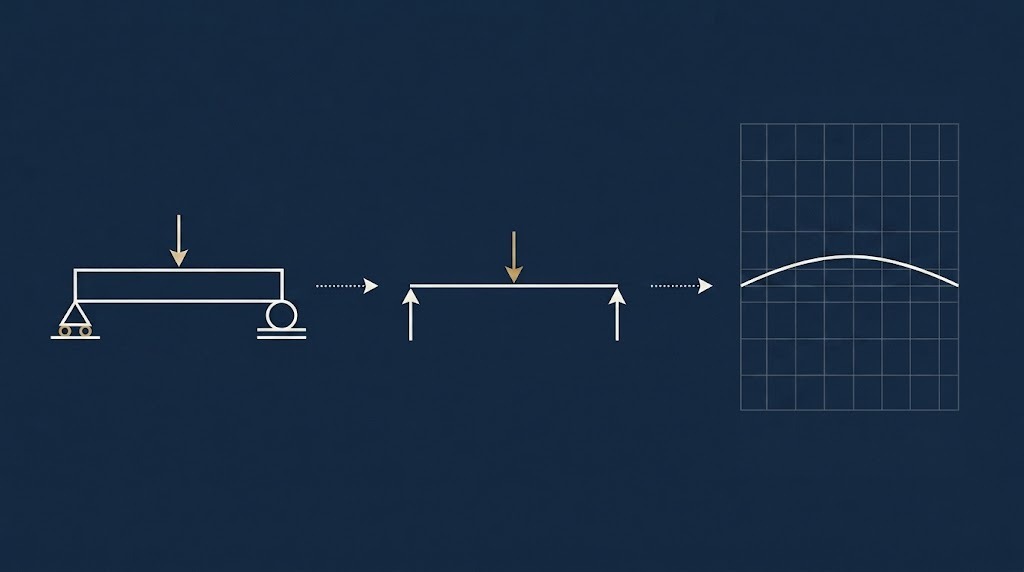
The diagram is the work. In this sequence a correct free-body or control-volume diagram determines the answer. Most sessions spend more time before the first equation than after it, and that is deliberate.
Assumptions get stated out loud. Frictionless, massless, steady, incompressible, quasi-static — these are the difference between a solvable problem and a research project, and knowing which one a problem intends is a skill, not a lookup.
Units and magnitudes are checked every time. A stress in kilopascals when it should be megapascals is a caught error in session and a lost exam otherwise.
I read your syllabus first. Notation and sign convention vary enough between instructors that teaching a different convention than your professor actively hurts.
Who this is not a fit for
- Graduate-level or research work. This is undergraduate core-sequence tutoring.
- Software-tool training — SolidWorks, ANSYS, MATLAB toolboxes — as a subject in itself.
- Anyone needing project deliverables or lab reports produced. I will help you understand the analysis; the submitted work has to be yours.
- Courses outside the list above. Ask rather than assume.
Common questions
Is there prepared practice material for these courses?
Not a stock problem set. The ASVAB has prebuilt packets because that exam has one fixed, published blueprint; university coursework varies too much between instructors for a generic set to be worth as much as preparation aimed at your actual course. Send the topics, the assignment or the exam coverage ahead of time when you can, and I will prepare around those before we meet.
Can you help the night before an exam?
Yes, subject to availability, and it is the least effective way to use me.
What does a session include?
A full video recording, a high-resolution PDF of everything written on the whiteboard, and a syllabus review before the first session. More on how sessions run →
Online or in person?
Online anywhere in the United States. In person by appointment within approximately 15 minutes of ZIP code 23462 in Virginia Beach, including Oberndorf Central Library.
What if I need more than one of these courses?
Common, and it works well — the sequence shares its habits, so the second course is usually easier than the first.
Related subjects
- Statics →Where the sequence begins, and the course whose habits every later one assumes you already have.
- Dynamics →Statics with everything moving, and the course where choosing between force, energy and momentum becomes the real work.
- Thermodynamics →Where the system boundary becomes the whole problem, and the accounting has to be set up before anything is calculated.
- Fluid Mechanics →The other control-volume course, and the one where a valid equation used outside its conditions costs the most marks.
- Physics →The prerequisite this sequence is built on. Mechanics is where the free-body diagram is first learned.
- Calculus →The math these courses spend rather than teach — and often the real reason an engineering course feels impossible.
“At first, I was worried about taking Dynamics as I knew it was a challenging course, but Ben helped me navigate through it with his tutoring, and helped with certain concepts and problems I didn't understand. He is really nice, patient, and understanding of his students which makes it easy to ask him any questions or doubts.”
Tell me which topic broke first.
Send the course, the textbook, and the problem you are currently stuck on. I will tell you what I think is actually going wrong before anything is scheduled.
Start an inquiryStart here and tell me what you're working on — when I reply you can send your syllabus, problem set, or a photo of the work.